If you are a business trading in the UK, you need to work out if you should be VAT registered. Put simply, if you have turnover that has exceeded £90k in the past 12 months or if you think it will exceed this value in the next 30 days (for example if you have just signed a high value contract that goes over this limit in the next 30 days), you may need to be VAT registered, but not necessarily.
Why only ‘may’? This is due to a bit of complexity at this stage – you only actually need to VAT register if your sales are subject to the standard or zero rate of VAT (these are called ‘taxable sales’), not if they are VAT exempt (‘exempt sales’). A further nuance is that you can apply to not be VAT registered if you only make zero rated sales.
So from this overview, you can see that you need to be able to distinguish between standard rated, zero rated and exempt sales. This article homes in on one of these – zero rated sales, and explains what qualifies for zero rating and the impact on VAT recovery on costs.
In VAT we use the jargon ‘supplies’ to mean sales/activities/revenue you have from selling goods or services so you will see reference to this below.
What Is a Zero-Rated Supply?
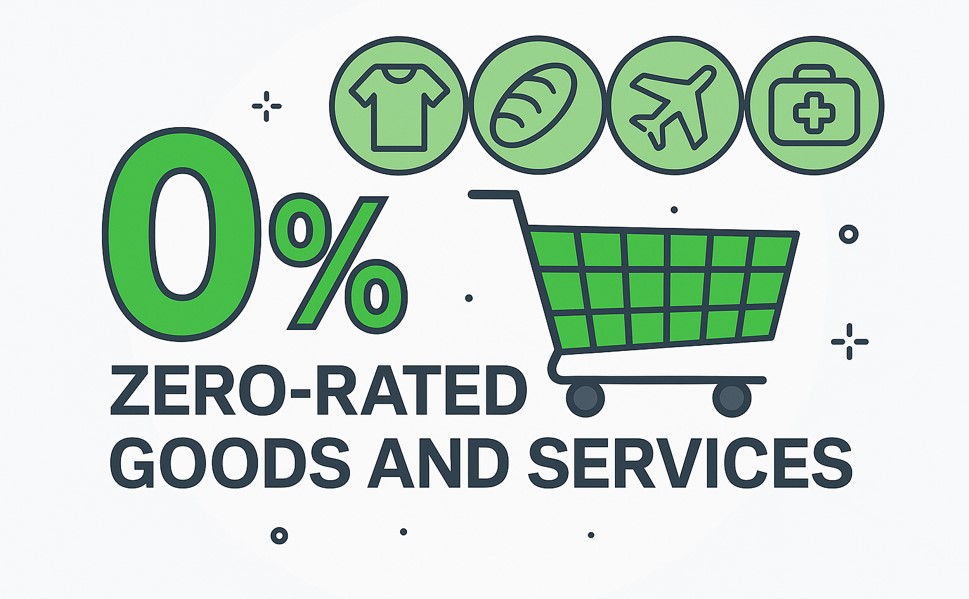
A zero rated supply is a sale of goods or services where the rate of VAT applying is 0%. The UK is fairly unique in Europe in having the zero rate as one of our reduced rates of VAT – most other European countries have positive rates for their reduced rates for domestic sales.
In terms of the types of goods and services that the zero rate applies to, the list of categories is as follows – a word of warning – as with most things VAT the devil is in the detail, so make sure you are fully aware of the scope of any zero rating relief and whether your activities qualify before going ahead:
-
- food and drink sector
- sewerage services and water
- books etc
- talking books for the blind and disabled and wireless sets for the blind
- construction of buildings etc
- protected buildings
- international services
- transport
- caravans and houseboats
- gold
- banknotes
- drugs medicines aids for the handicapped etc
- exports etc
- charities
- clothing and footwear
- women’s sanitary products
- personal protective equipment in brackets coronavirus
- online marketplaces deemed supplies
- free zones installation of energy saving materials
- ERICs
The list contains many niche items along with broad categories such as imports and exports and international services. However it also contains mainstream zero items there is generally a good awareness about eg most but not all food, children’s clothing, books, certain passenger transport.
- Arguably, the most complex of these areas is the ‘food and drink vat’ category which has a huge level of detail and many pitfalls. This area has been the subject of lots of VAT litigation with HMRC.
- If you are not sure if your goods or services qualify as zero-rated, The VAT Consultancy can review your business transactions to ensure compliance and ensure you can take advantage of any VAT reliefs available.
- Finally in this section, transactions with international customers tend to be zero rated (subject to conditions), so exports of goods and most B2B services.
Zero-Rated vs Exempt Supplies
Whilst it is clear that standard rates supplies are different as they are subject to a 20% rate of VAT in the UK, confusion arises in relation to the difference between zero rated and exempt supplies and we are regularly asked what the difference between the two is and why it is important to distinguish between the two in accounting systems and on invoices.
The fundamental reason for the confusion lies in the fact that both carry a 0% rate of VAT. So what’s the difference and does it matter how you describe them in your invoices and accounting system? There is a significant difference, and this lies in 3 key areas:
-
- You can fully reclaim VAT on costs related to your zero rated supplies whereas you cannot reclaim VAT on costs related to your exempt supplies
- You can’t/aren’t required to register for VAT if you only have exempt supplies
- The types of goods and services qualifying for the VAT zero rate or VAT exemption differ
So although both zero rated and exempt activities both carry a 0% rate of VAT, its really important that people in your business responsible for VAT accounting/raising invoices etc are aware of the difference so that the correct VAT treatment can be applied.
A further complication arises in relation to terminology – in the UK we use the term ‘zero rated’ to describe transactions where VAT recovery is permitted and ‘exempt’ where it is not. In continental Europe however, they tend to use the terminology ‘exempt with recovery’ and ‘exempt without recovery’.
Why the Zero-Rate Matters to Your UK Business
With zero-rated supplies:
-
- No VAT is charged to customers
- You have the ability to reclaim input VAT on purchases
- This means you have improved cash flow and reduced tax burdens
- You can file monthly rather than quarterly VAT returns with HMRC meaning you get refunds more quickly if you are in a repayment position of making more zero rated than standard rated sales
- If you do not incur much VAT on costs and only have zero rated sales, you can apply to be exempt from VAT registration, meaning you do not have the admin burden of filing VAT returns or the cost associated with outsourcing this task.
If you operate in a B2C environment, even if this means you sell your products to a retailer who onsells to consumers, applying the zero rate where this is feasible can have a really key impact on pricing within the supply chain. As VAT sticks at a cost at the retail stage, if you can zero rate a product (and eg a supermarket can in turn when it sells), your pricing can be approx. 20% cheaper (although prices are inclusive of 20% VAT so it’s slightly less than 20%) meaning the products are more attractive to the consumer ultimately. In addition or alternatively, the margins increase if you retain the same price.
We find that particularly in the food and beverage area, the VAT legislation is so complex with lots of grey areas and frankly nonsensical distinctions, that many businesses miss out on zero rating as they are not aware of the parameters of the relief (eg potato crisps versus tortilla chips – the former is standard rated whilst the latter is zero rated).
On the flip side, you need to tread carefully if you operate in a B2C environment and have eg an innovative food product not clearly envisaged in the VAT legislation. Zero rating without being 100% certain of the correct VAT treatment can lead to significant demands for additional VAT going back 4 years (if you are VAT registered and longer if not) along with penalties and interest.
The VAT Consultancy has had lots of success in this area recently for clients including in the Innovative Bites ‘Mega Marshmallows’ litigation against HMRC. We’re happy to have an initial call with you to determine whether we think your product might qualify for zero rating.
Common Misconceptions About Zero-Rated Supplies
“I can’t reclaim VAT on zero rated supplies” – you can’t reclaim VAT on a zero rated item you purchase, but if you sell zero rated products you can reclaim VAT on business costs.
“All food and drink items are zero rated” – there is a huge number of items where this is not the case, including the infamous chocolate covered biscuits, confectionery products, alcohol, fruit juices and smoothies, hot takeaway food (a minefield in its own right)
“All children’s clothes and shoes are zero rated” – complex sizing and ‘held out for sale’ rules apply here and they differ by type
Managing VAT risk with Zero Rated Supplies
Practical steps to ensure compliance, such as:
-
- Make sure you are 100% certain your products are zero rated before you treat them as such
- Retain evidence to support why they are zero rated if this is not straightforward
- Staying updated on HMRC rules and VAT court decisions, especially with food items
- Take specialist VAT advice if you are unsure
FAQs About Zero Rated Supplies
Can I reclaim VAT on zero-rated supplies?
- Yes, if correctly classified.
What if I make a mistake in my VAT returns?
- Errors can be corrected, but timely action is crucial.
Do I need to charge VAT on zero-rated goods?
- No, but supporting documentation is required in some cases eg exports to evidence their shipment overseas.
Can zero-rated supplies impact VAT registration thresholds?
- Yes, include this in your calculations.
My business has zero rated and exempt income. Do I need to distinguish between the 2 types or can I use a tax code with 0% VAT for both?
- No, use a different code for each type so you can work out how much VAT you can reclaim on costs
Still have questions? Book a free consultation with The VAT Consultancy to get personalised advice.
Key Takeaways for UK Businesses
Make sure you are clear on the difference between zero rated and exempt activities and that you are reclaiming VAT on costs accordingly
If you are VAT registered and are in a repayment position each period, consider the cash flow benefit of moving to monthly VAT returns – more admin but better cashflow
If you think zero rating applies to your activities, make sure you are certain and seek professional VAT advice if not
The VAT Consultancy can be your partner doing the heavy lifting, ensuring peace of mind and better financial outcomes for you and your business.
Don’t let VAT complexities slow your business down – let The VAT Consultancy guide you through them. The VAT Consultancy is highly experienced and provides relevant and practical advice to help you deal with the VAT and customs duty issues your organisation faces. To discuss how we can help contact us today.